
FAQ
To easily enjoy the virtual tours we've selected on our website, you need to click on the Browser icon in the Library menu from your Meta Quest headset. Then, simply type 'TheTiger Butterfly.com/en' in the Google browser to access all the virtual tours available on our site. For example, if you want to visit the Dalí Theatre-Museum, go to the page dedicated to it on our website, then click on the Matterport virtual tour available there. You can continue your journey around the world by visiting the Matterport website, again through the browser on your virtual reality headset.
On the Meta Quest Store, the platform for purchasing virtual reality apps, there is a wide variety of applications that cover different genres and types of experiences: action and adventure games, sports, fitness, multiplayer games, meditation, relaxation, as well as educational, creative, and artistic apps, and even immersive travel experiences. Social VR apps allow you to meet people, chat, and share immersive experiences. Productivity and workspace apps can help optimize your work, organize meetings, or even create immersive environments for collaborative work.
The Meta Quest headsets we offer on our site start at around $300. The price varies depending on factors such as storage capacity and visual resolution, and can go up to around $790 for a model with advanced technical features. As for games, you can expect to pay between $20 and $60. There are also many free apps or those with freemium models (free access to certain features), which allow you to try out a lot of content before making your purchase decision.
Meta Quest headsets use a system called Guardian to define a safe play area. Before you start playing, you set up a secure zone in your space, which you can adjust based on the space available to you.
Meta recommends a minimum area of 6.5 feet x 4.9 feet, which allows you to move around a bit without risking bumping into furniture or objects.
For a more immersive and smooth experience, a 9.8 feet x 9.8 feet area is ideal. This gives you the freedom to move, jump, bend, and turn without worrying about your furniture or objects.
Meta recommends a minimum age of 13 to use Meta Quest headsets due to risks related to eye health and content management.
Teenagers (ages 13 and up) can safely enjoy VR through age-appropriate games and experiences.
Children may find virtual reality very exciting, but it is important to limit session length to avoid eye strain or headaches. Sessions of 15 to 30 minutes are generally recommended for younger users.
Children tend to move more erratically when immersed in virtual worlds, so it is crucial to set up a clear play area and properly use the Meta Quest Guardian system to prevent them from getting hurt by bumping into objects.
It is essential to check game ratings and use the headset’s parental control tools to restrict access to adult content.
Virtual reality (VR) experiences can be very beneficial for seniors, particularly for stimulating cognition, improving physical fitness, encouraging social interaction, and reducing stress. However, it is essential to adapt the experiences to individual needs and take precautions to ensure safety and comfort.
Some VR applications can be somewhat complex to navigate, especially for older adults who are not familiar with new technologies.
Although VR offers immersive experiences, it often involves physical movements (jumping, bending, turning). It is important to make sure the environment is clear and free of obstacles to prevent accidents. Playing while seated or in a space with enough room is recommended.
Some seniors may have difficulty using VR headsets due to vision issues or eye strain. It is important to limit sessions to 15–30 minutes and take regular breaks to avoid visual fatigue. The headset should be properly adjusted to prevent headaches and discomfort.
If the senior is in good health and uses applications suited to their abilities, virtual reality can offer an excellent way to stay active, engaged, and connected.
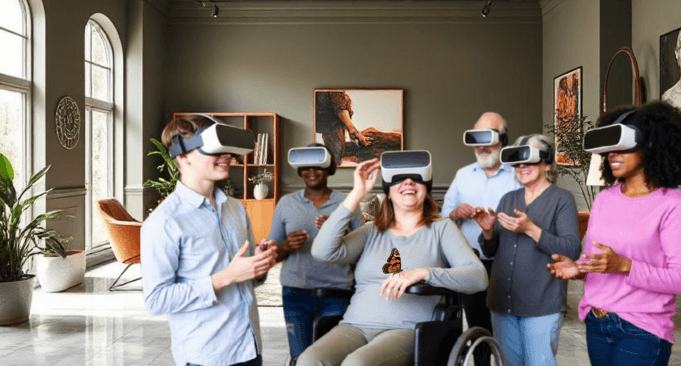
VR makes it possible to recreate environments—such as historical landmarks, museums, or natural landscapes—so they can be accessed from anywhere. This removes physical barriers that can make certain places difficult to access for wheelchair users, such as stairs or uneven paths.
Virtual VR tours can offer full immersion, allowing users to “move around” freely in a 3D environment. This can be especially appealing for tourist sites or exhibitions, where users can “explore” every room and corner as if they were physically there.
It is possible to set up the play area to ensure the experience is suitable for seated use.
In addition, more and more games are designed to be playable with a single controller, allowing people with limited use of one hand to continue enjoying games comfortably.
There are several virtual reality games and applications specifically designed to promote physical exercise and help with weight management while having fun.
Another major advantage of virtual reality is the convenience of being able to exercise regularly at home. For some people, going to a gym can be a barrier due to lack of time, motivation, or self-confidence. Virtual reality allows them to avoid this obstacle while providing an immersive experience that makes exercise more enjoyable.
Thanks to VR, people can attend immersive meetings or events without needing to travel, which reduces CO₂ emissions associated with transportation.
Companies can organize virtual trips or meetings to replace travel by plane, car, or train.
VR also provides full immersion in scenarios that visually and tangibly show the effects of climate change. For example:
Users can “experience” extreme events such as heat waves, floods, or wildfires, which can create a stronger awareness than traditional numbers or images.
Users can virtually visit tropical forests, coral reefs, or glaciers and see how these ecosystems are affected by global warming.
Virtual reality thus helps promote environmental awareness.
By providing immersive experiences—from education to rehabilitation, as well as reducing social isolation and supporting mental well-being—virtual reality can play a very positive role for people who are placed under house arrest or restricted from leaving a territory. It can not only improve their quality of life during this period but also help them prepare effectively for a successful reintegration into society.
LEARN MORE ABOUT VIRTUAL REALITY